
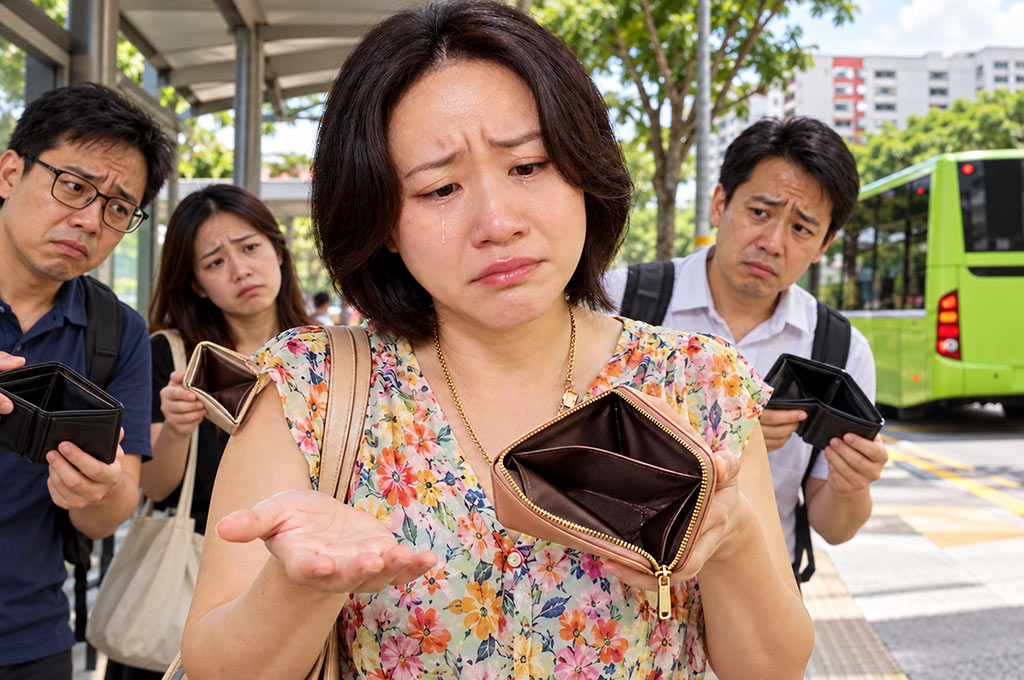
SINGAPORE — Following five years of annual fare increases, Singapore has announced another round of public transport fare hikes, assuring residents that assistance will be provided to help them afford the prices being increased to finance the assistance.
Officials described the latest adjustment as necessary to maintain a sustainable transport system, under which commuters can sustainably expect to pay more every year.
“We understand Singaporeans are concerned,” said a minister, unveiling an $80 public transport voucher for eligible households. “That is why we are helping them cope with this entirely unavoidable event that we announce at roughly the same time every year.”
The minister explained that the vouchers would cushion the impact of the increase, much like placing a small pillow on someone before dropping another brick.
Commuters welcomed the opportunity to have some of their money returned in a format that could only be used to pay the higher prices.
“Most of the people taking these buses and trains live here,” said one commuter. “If you raise what we pay, then give us money to pay it, could we perhaps skip the middle part?”
Officials clarified that skipping the middle part would deprive residents of the reassurance that the Government was helping.
Another commuter asked whether the vouchers would continue indefinitely.
“The fare increase is permanent,” the minister replied. “The assistance is something we will review. This gives Singaporeans the certainty they need, together with the uncertainty required to appreciate it.”
Meanwhile, sources inside a wholly fictional inter-ministerial task force revealed that the fare increase served an additional purpose: making it harder for Iris Koh to get to court.
Having exhausted increasingly elaborate legal mechanisms to restrain litigation, the task force had reportedly concluded that the missing instrument was a sufficiently expensive bus ride.
“We have tried court orders,” said one imaginary official. “But has anyone tried making the journey there slightly more inconvenient?”
Under the plan, Koh—assumed by the committee to have no income available for transport—would eventually be forced to walk to her legal appointments, significantly reducing the number of proceedings she could fit into a working day.
“This is a distance-based approach to reducing litigation,” the official explained. “Every kilometre she walks is a kilometre during which she is occupied.”
Asked whether Koh could simply cycle, officials acknowledged a potential loophole, provided someone sponsored her a bicycle.
A contingency paper recommended monitoring crowdfunding campaigns for phrases including “access to justice”, “urgent appeal” and “seven-speed Shimano”.
The ministry insisted that inconveniencing millions of other commuters to slow down one person represented an efficient whole-of-government solution.
As the briefing concluded, a reporter asked whether fares would fall when the Iran war ended and oil prices came back down.
The minister shook his head.
“Even after the war stops, ministerial salaries will not,” he said. “So we will need to keep prices up.”